
Railway capacity is often presented as a signalling problem: reduce block lengths, introduce ETCS Level 2, then move towards Hybrid Train Detection or Moving Block.
This view is useful, but incomplete. Capacity is not created by signalling alone. It emerges from the way train detection, train positioning, train integrity, braking curves, traffic management, operational rules, rolling stock performance, infrastructure data and traffic regulation work together.
This article explains the migration from fixed-block signalling towards more dynamic train separation principles. It shows why Hybrid Train Detection and Moving Block should be understood as system capabilities, not isolated signalling features. The question is not only how to reduce the distance between trains. It is how the railway system can safely transform a tighter capacity envelope into usable operational capacity.
Recommended reading
For a good understanding of the concepts discussed in this article, I recommend reading first:
Executive Summary
Capacity is one of the strategic questions of the future European railway. New infrastructure will remain necessary in many contexts, but it is expensive, slow to deliver and often difficult to build. Existing infrastructure must therefore be used more efficiently, especially on dense metropolitan networks, mixed-traffic corridors and routes where passenger and freight demand compete for limited paths.
Signalling directly influences capacity because it defines how close trains can safely run. In fixed-block systems, the railway is divided into physical sections. A following train can only be authorised according to the occupation and protection logic of those sections. The block boundary becomes one of the basic units of the capacity system.
ETCS Level 2 digitalises signalling through cab signalling, radio communication, trackside-generated Movement Authorities and continuous onboard supervision. It is a major step in the evolution of railway control-command. But conventional ETCS Level 2 does not automatically remove fixed-block logic when physical train detection sections remain the basis for movement authority generation.
Hybrid Train Detection is a first step towards virtualising this logic. It keeps a physical train detection layer, but adds smaller virtual sections above it. If a train can safely report its position, confirmed length and train integrity, the trackside system can use rear-end information to release infrastructure more finely. This can reduce headways without necessarily installing denser physical train detection.
Moving Block goes further. It aims to move from fixed or virtual sections towards a more dynamic and train-centric separation logic. The system manages train objects, safe front ends, safe rear ends, movement permissions, infrastructure asset states and operational data. The train is no longer only detected by the infrastructure; it becomes an active contributor to the capacity architecture.
This shift has strong dependencies. The system must know where the train is, where the train ends, whether it is complete, what infrastructure it is running on, which assets are aligned, which restrictions apply and which operational constraints must be respected. This makes Advanced Safe Train Positioning, Train Integrity Monitoring, confirmed train length and reliable static infrastructure data essential enablers.
The migration challenge is particularly important for freight and variable-composition trains. Modern multiple units are easier to equip because they have integrated onboard systems, known consist configurations, train buses and stable technical architectures. Legacy freight trains are harder because they may have older wagons, mechanical couplers, no continuous electronic train bus and only pneumatic brake continuity. Digital Automatic Coupling and electro-pneumatic braking may therefore become important enablers of future train-centric capacity.
From an architecture perspective, Hybrid Train Detection and Moving Block are not only advanced signalling functions. They are part of a broader migration towards a different capacity architecture, where some functions move from trackside equipment towards trains, onboard systems, data, software, certification, cybersecurity and lifecycle maintenance. The business case must therefore be assessed at system level, not only from the infrastructure manager’s perspective.
The future capacity architecture is not only about reducing blocks. It is about making trains, infrastructure, data, traffic management and operations work together with enough precision, safety and predictability to run the railway closer to its real potential.
Last modified: 2026-06
This article by Bastian Simoni is licensed under CC BY-NC-SA 4.0


Written by Bastian Simoni
Bastian Simoni is a railway system architect working at the intersection of signalling, automation and digital railway operations. Voie Libre is his personal blog on the system architecture behind the future European railway: ERTMS, DATO, automation, migration and interoperability.
Content
- Why existing infrastructure capacity matters
- Capacity starts with safe train separation
- ETCS Level 2: digitalising fixed-block signalling
- Hybrid Train Detection: the first layer of virtualisation
- The onboard enablers: position, integrity and length
- Freight and the migration challenge
- Digital Register: the static data backbone
- Moving Block: towards train-centric separation
- Why ERTMS/ATO and TMS become necessary
- The cost-benefit question
- Architecture perspective
- Conclusion
1. Why existing infrastructure capacity matters
Railway capacity is becoming a strategic issue.
Demand for rail transport is expected to increase in many regions. Metropolitan areas need higher frequency. Long-distance corridors need more passenger and freight paths. Climate policies encourage modal shift. Rail is expected to carry more traffic while remaining affordable, resilient and operationally reliable.
The simplest answer would be to build more infrastructure. In some cases, this is unavoidable. New lines, additional tracks, grade-separated junctions, larger stations and new terminals will still be needed where demand exceeds what the existing network can reasonably absorb.
But new infrastructure is difficult. It requires land, planning, environmental assessment, public funding, construction capacity, political support and social acceptance. It can take decades. In dense urban areas, new tracks are extremely expensive. In rural or environmentally sensitive areas, projects may face opposition. Even when the business case is strong, delivery can be slow.
This creates a strategic need to use the existing network better.
Advanced signalling is one part of that answer. If the railway can safely reduce the separation between trains, it can increase the theoretical capacity envelope of existing infrastructure. If the system can also operate trains more precisely, more predictably and more consistently, part of that theoretical capacity can become usable operational capacity.
This is where ETCS, Hybrid Train Detection and Moving Block become important. They are often presented as signalling concepts, but their real value is broader. They change the relationship between train detection, train positioning, infrastructure data, train integrity, operational rules and traffic management.
They also raise a system-level question: where should the intelligence of future railway capacity be located?
In traditional signalling, much of the capacity logic is embedded in trackside equipment, physical sections and route-based control. In a more train-centric architecture, some functions move towards the train: safe positioning, confirmed train length, train integrity and more dynamic interaction with trackside systems.
This does not make the infrastructure disappear. Points, routes, restrictions, level crossings, stations and operational constraints remain. What changes is the allocation of functions between train and trackside.
That is why capacity is an architecture question, not only a signalling question.
2. Capacity starts with safe train separation
A railway cannot be filled with trains without considering how far apart those trains must remain to operate safely. Each train needs a Movement Authority. It needs braking distance. It needs speed supervision. It needs protection against conflicting routes. It needs assurance that the track ahead is available, safe and correctly configured.
The following train cannot simply move up to the rear of the preceding train. The signalling system must ensure that the following train can stop before a danger point, even if the preceding train stops or if the Movement Authority cannot be extended.
This is why train separation is central to capacity.
In a fixed-block railway, the line is divided into track sections. These sections are detected by track circuits, axle counters or other train detection systems. If a section is occupied, the following train cannot normally be authorised into it, or can only do so under restrictive conditions. The block boundary becomes the basic granularity of the capacity system.
The shorter the safe separation, the more trains can theoretically run on the same infrastructure. But reducing train separation requires more information. The system must know where the train is, how far it is authorised to go, whether the train ahead has completely cleared the track, what braking capability the following train has, which gradients and speed profiles apply, which trackside assets are aligned, and whether the data used to calculate the authority are reliable.
The key question is therefore not only where the front of the train is. It is also where the rear of the train is.
This distinction is fundamental. The front end tells the system where the train has reached. The rear end tells the system what has actually been cleared behind it. If the railway wants to reduce separation between trains, rear-end information becomes essential.
Capacity therefore starts at the rear end of the train.
This is why train integrity and train length become central to Hybrid Train Detection and Moving Block. They are not secondary train data. They become capacity inputs.
3. ETCS Level 2: digitalising fixed-block signalling
ETCS Level 2 is a major step in railway signalling digitalisation. It introduces cab signalling, radio communication, trackside-generated Movement Authorities and continuous train supervision. The driver receives movement information in the cab. The train communicates with the Radio Block Centre. The onboard system supervises speed and distance against the Movement Authority.
In full ETCS Level 2 operation, lineside signals may disappear from the driver’s perspective. This is an important change because the driver no longer relies primarily on external signal aspects. Movement information is transmitted to the train, displayed in the cab and supervised continuously onboard.
But this does not mean that ETCS Level 2 automatically removes fixed-block signalling.
In conventional ETCS Level 2 implementations, the infrastructure is still generally divided into physical train detection sections. These sections are monitored by track circuits, axle counters or equivalent trackside train detection systems. The interlocking and the Radio Block Centre use route status, train detection status and signalling logic to generate Movement Authorities.
The fixed-block logic therefore remains. What changes is the way the information is transmitted and supervised. The authority is no longer displayed mainly by lineside signals. It is transmitted by radio and supervised continuously onboard.
This distinction is essential because ETCS Level 2 is digital signalling, but it is not necessarily Moving Block. It can remove lineside signals while still relying on fixed physical train detection sections. It can bring cab signalling, continuous supervision and interoperability without necessarily changing the underlying capacity granularity of the infrastructure.
Hybrid Train Detection starts from this point. It does not come after a fully dynamic ETCS Level 2. It comes after conventional Level 2 fixed-block operation and adds a virtual layer above the physical train detection sections.
The future capacity architecture is therefore not “install ETCS Level 2 and get Moving Block”. It is a sequence of architectural steps: digitalise signalling, virtualise train detection, introduce more reliable train information, then move progressively towards train-centric separation.
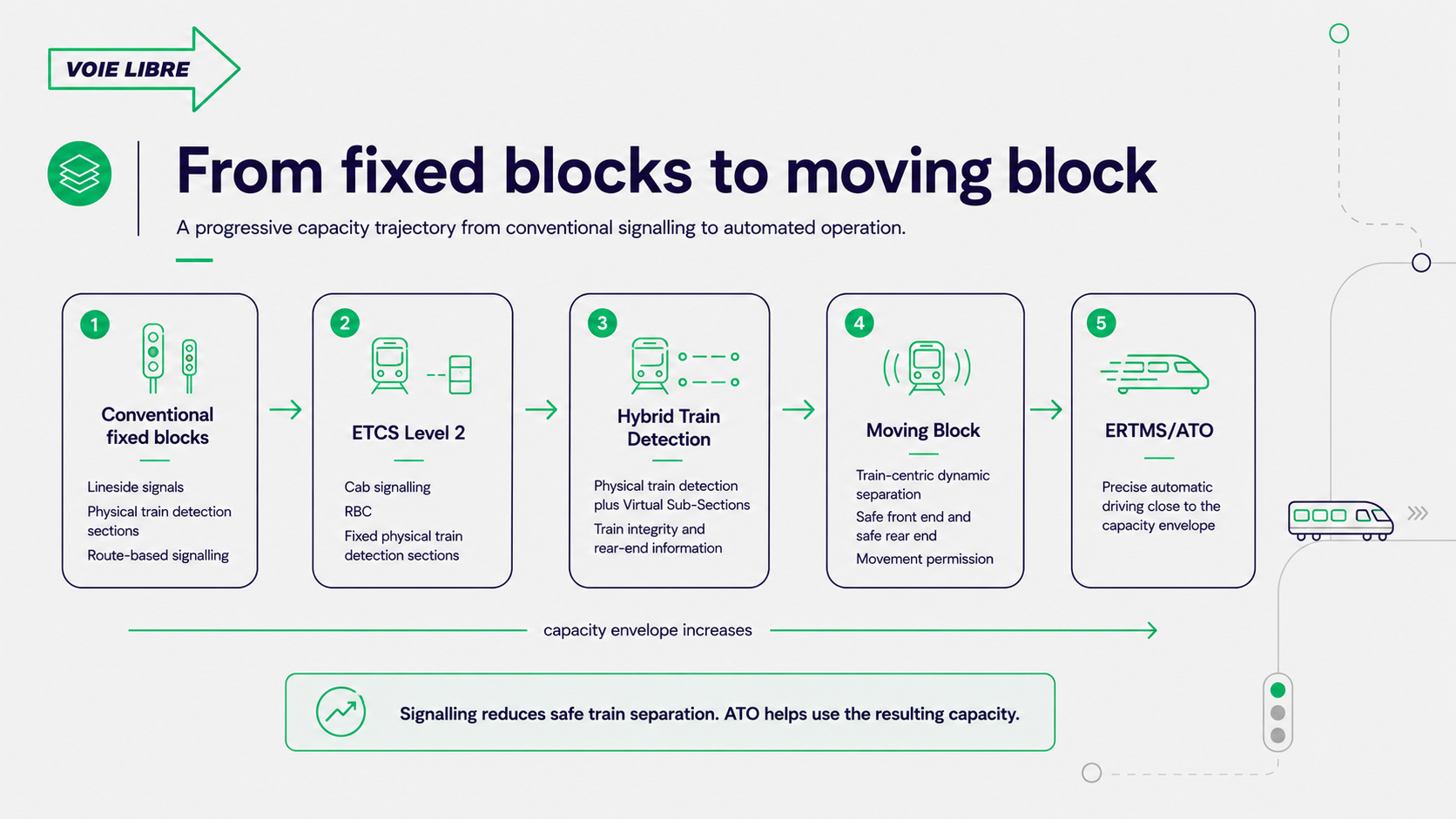
Figure 1 — From fixed blocks to Moving Block: the capacity trajectory from conventional signalling to automated operation.
4. Hybrid Train Detection: the first layer of virtualisation
Hybrid Train Detection is a pragmatic step between conventional ETCS Level 2 and Moving Block.
The principle is to keep part of the physical train detection layer while adding smaller virtual sections inside physical sections. Instead of treating a physical section as one indivisible occupied or free object, the system can divide it into Virtual Sub-Sections.
These virtual sub-sections are not detected by additional trackside equipment. They are calculated by the trackside system using information provided by the train: position reports, confirmed train length and confirmation that the train remains complete.
If the train can confirm its integrity, the system can use reported rear-end information to determine which virtual sub-sections have been cleared. The following train may then receive a Movement Authority closer to the rear of the preceding train. This can reduce headways and limit the need to install denser physical train detection equipment. Instead of dividing the infrastructure into more and more track circuits or axle counter sections, the system creates a finer virtual granularity.
This is the architectural value of Hybrid Train Detection: it increases capacity granularity without necessarily increasing trackside equipment density.
The word “hybrid”, however, is important. Hybrid Train Detection does not simply remove trackside train detection. It keeps physical detection for migration, degraded operation, non-equipped trains, trains unable to confirm integrity, and situations where onboard information is unavailable or unreliable.
Hybrid Train Detection is therefore both a capacity step and a migration compromise. It does not require every train to be immediately capable of full train-centric operation. It can provide benefits for trains able to deliver the required information while still allowing less capable trains to operate under more conventional principles.
This is why Hybrid Train Detection is important for Europe. It recognises that the railway is a brownfield system. It does not assume that all rolling stock will be upgraded at the same time. It creates a path from today’s physical detection logic towards tomorrow’s more train-centric capacity architecture.
Hybrid Train Detection is not the final target. It is the first controlled layer of virtualisation.
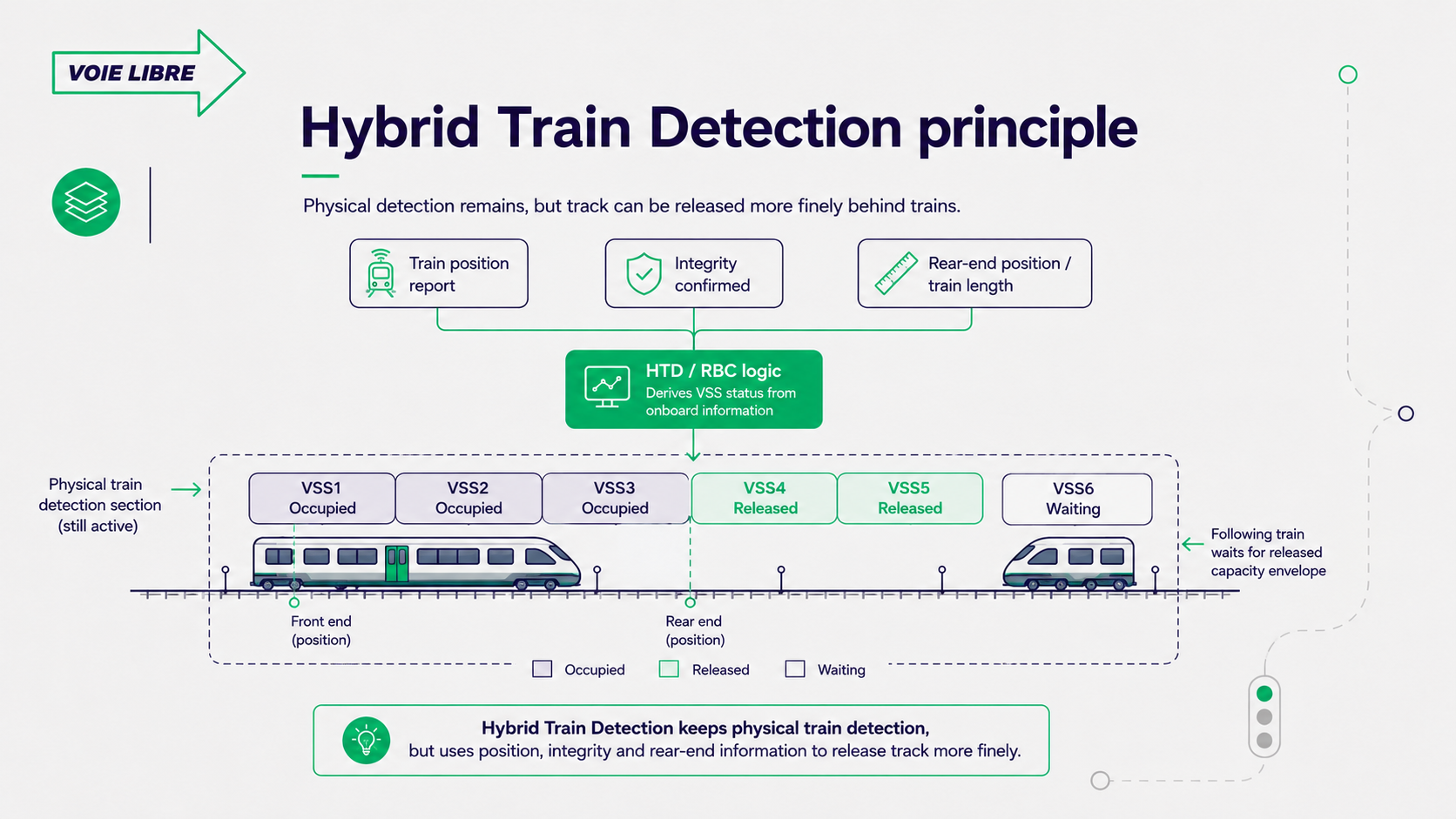
Figure 2 — Hybrid Train Detection principle: physical detection remains, but virtual sub-sections allow track to be released more finely.
5. The onboard enablers: position, integrity and length
Hybrid Train Detection and Moving Block both require the train to become a more reliable source of information.
This is a major architectural shift. In conventional fixed-block signalling, the infrastructure detects train presence. Track circuits or axle counters determine whether a section is occupied. The train does not need to tell the trackside system exactly where its rear end is for the block to remain safely protected.
In Hybrid Train Detection, this changes. The trackside system can release infrastructure more finely only if it knows where the train is, where the train ends and whether the train remains complete.
Three onboard capabilities therefore become central.
The first is safe train positioning. The system must know the location of the train with sufficient confidence. Advanced Safe Train Positioning may combine odometry, balises, satellite positioning, inertial sensors, map data and other supporting inputs depending on the architecture. The detailed sensor fusion is not the key point here. The architectural point is simpler: if trackside train detection is reduced, the train must become more capable of safely locating itself.
The second capability is train integrity. Train integrity answers a safety-critical question: is the train still complete? If a train separates unintentionally, the front part may continue to report its position while the rear part remains on the track. In that situation, the infrastructure behind the front part cannot be considered safely clear. Without train integrity, rear-end-based capacity logic cannot be trusted.
The third capability is confirmed train length. Knowing the front of the train is not enough. If the system does not know the train length, it cannot calculate the rear end precisely. Without a reliable rear end, it cannot release the infrastructure behind the train at a finer granularity.
Together, these capabilities form the basis of train-centric capacity. The system must answer apparently simple questions in a safe, continuous and interoperable way: where is the train, where does it end, is it complete, and what infrastructure is it running on?
These questions are technically difficult because their answers become part of the safety and capacity architecture. Position, integrity and length are therefore not just onboard features. They are system inputs.
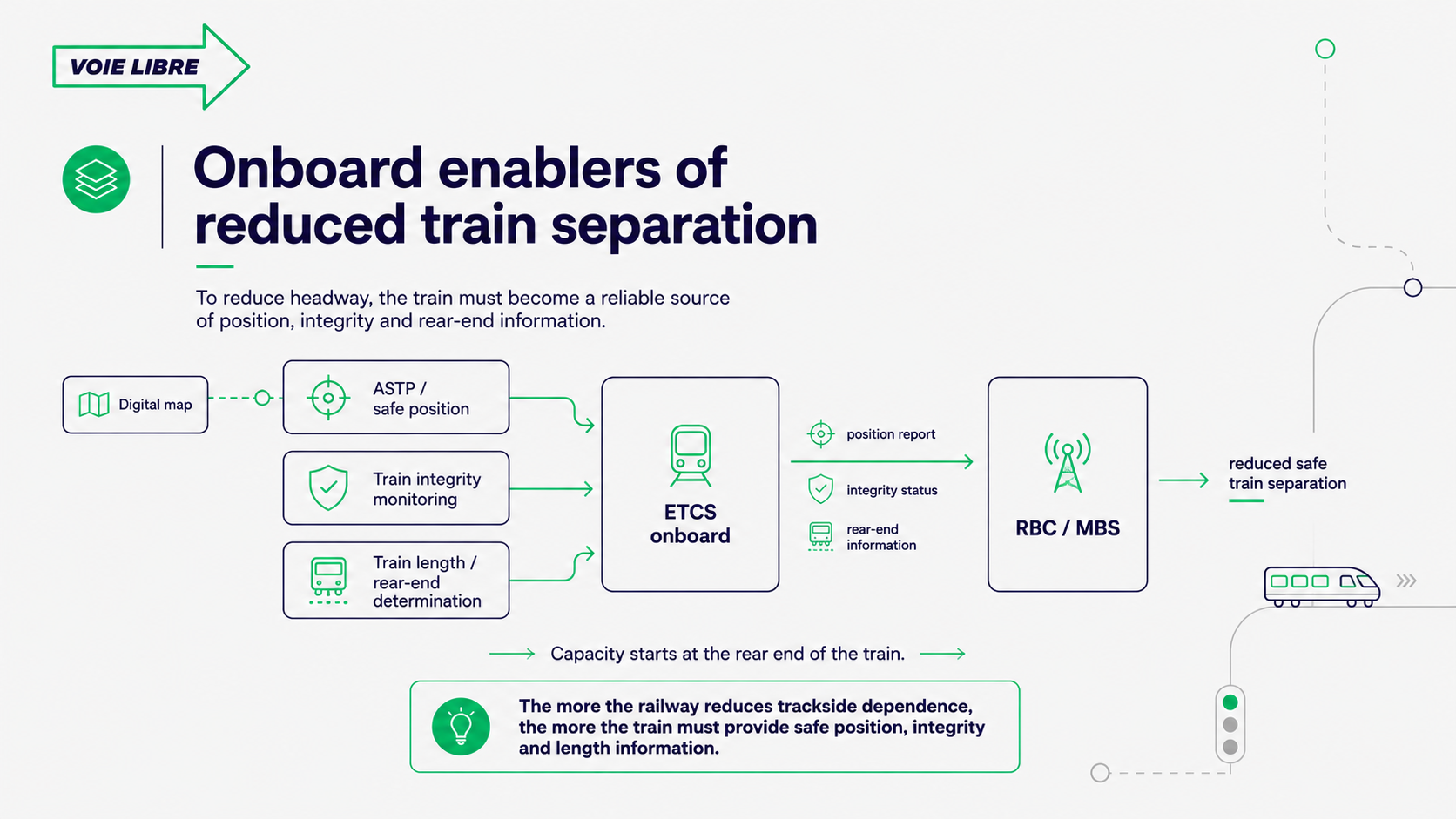
Figure 3 — Onboard enablers of reduced train separation: position, integrity and rear-end information become capacity inputs.
6. Freight and the migration challenge
Hybrid Train Detection and Moving Block are easier to imagine with modern passenger rolling stock.
Modern multiple units usually have integrated onboard systems, a train bus, known consist configuration, TCMS, onboard diagnostics and relatively stable train composition. Equipping such trains with train integrity, train length and advanced positioning functions is still a technical and economic challenge, but the architecture is favourable.
Freight is different.
A conventional freight train in Europe may be composed of wagons of different ages, owners and technical standards. Many wagons are old. They are mechanically coupled. The only continuous link along the train may be the pneumatic brake pipe. There may be no electronic train bus and no native onboard system able to determine the integrity or length of the full train.
This creates a major migration issue. If future capacity architectures require all trains to provide safe position, train integrity and confirmed train length, then part of the existing freight fleet may not be able to operate on the most advanced infrastructure without significant retrofit.
The same challenge may apply to locomotive-hauled passenger trains, push-pull trains, engineering trains, special trains and other variable-composition formations. A capacity architecture designed only around modern multiple units would therefore be too narrow for the European railway system.
This is where Digital Automatic Coupling becomes important. DAC is often discussed as a freight productivity enabler: automated coupling, digital continuity, better train composition management and more efficient yard operations. But in the context of Hybrid Train Detection and Moving Block, it may also become an enabler for train integrity and train length determination.
If wagons are connected through a digital coupling architecture, the train can become more visible to itself. Information can be exchanged along the train. The consist can be known. Integrity and length functions become more realistic.
Electro-pneumatic braking is another related topic. A long freight train using only conventional pneumatic brake propagation does not react like a modern multiple unit. Brake commands propagate progressively along the brake pipe, and on long trains this delay can be significant. A more dynamic capacity architecture must therefore consider braking performance, brake build-up time and predictability.
This does not mean that DAC or electro-pneumatic braking solve everything. They bring their own cost, retrofit, certification and maintenance challenges. But they show that capacity migration cannot be separated from freight migration.
The hardest part of train-centric capacity may not be the passenger train. It may be freight.
A capacity architecture that ignores freight risks creating a system that works technically but excludes part of the railway market from the most capable infrastructure. That would be a strategic mistake for Europe.
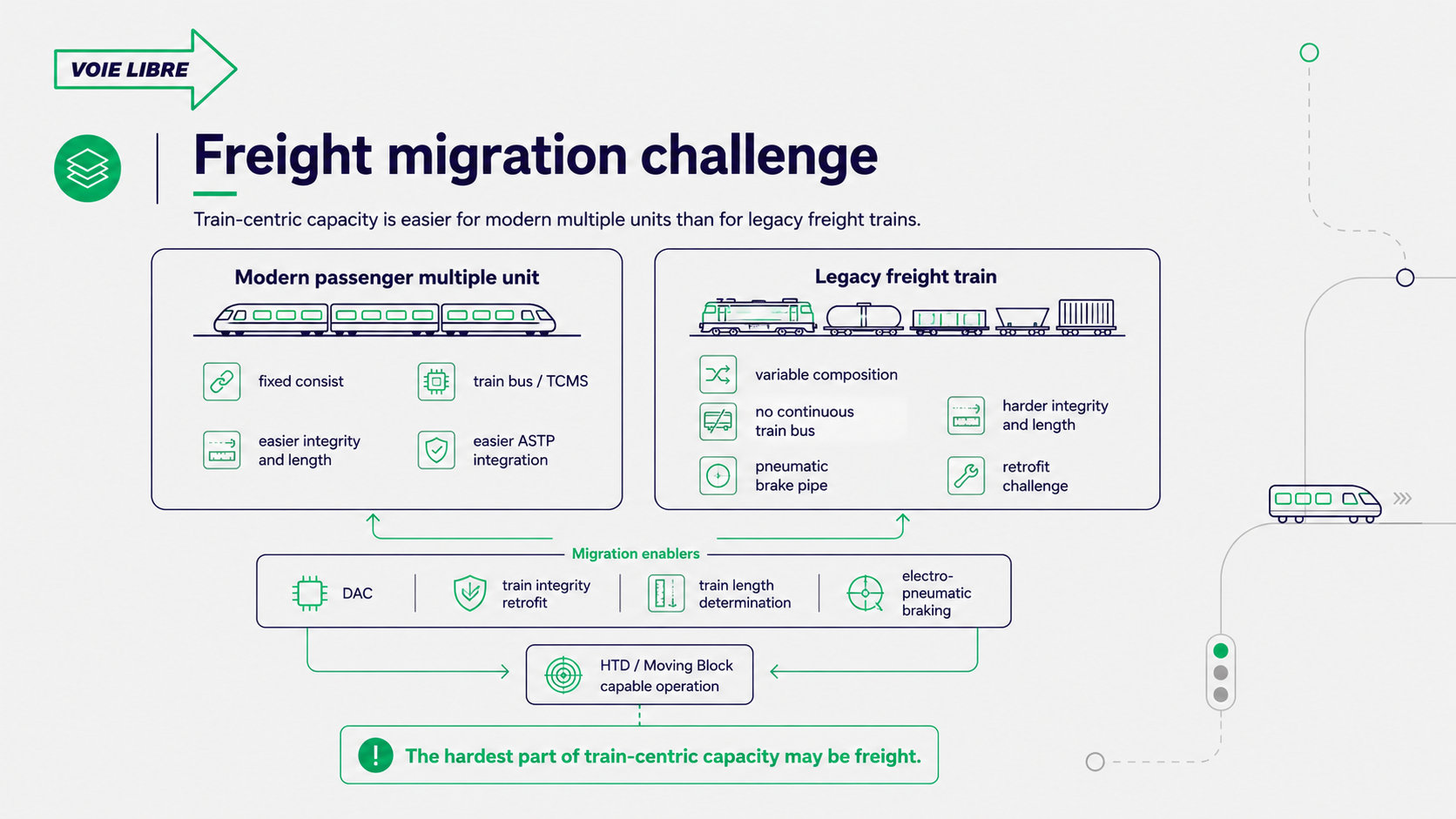
Figure 4 — Freight migration challenge: train-centric capacity is easier for modern multiple units than for legacy freight trains.
7. Digital Register: the static data backbone
A dynamic signalling system still depends on static data.
This may sound paradoxical. Moving Block is often described as dynamic because train separation becomes more dependent on train position, safe rear end, movement permissions, infrastructure asset states and operational data. But none of this can be safe or reliable if the underlying infrastructure data are wrong.
The system must know the topology of the network. It must know where tracks, points, gradients, speed profiles, boundaries, restrictions and trackside assets are located. It must know how infrastructure is connected. It must know which data version is valid. It must ensure that the same infrastructure description is used consistently by the systems that depend on it.
This is the role of the Digital Register.
The Digital Register should not be understood as a documentation database. It is part of the operational and safety architecture of digital railways. It provides reliable static infrastructure data to the systems that need it: Traffic Management System, Plan Execution, Moving Block System, Advanced Safe Train Positioning, perception systems, ATO and other DATO-related functions.
For Hybrid Train Detection and Moving Block, this is essential. If safe positioning uses map data, the map must be reliable. If the Moving Block System uses domain data to manage train movement, the domain data must be correct. If TMS and Plan Execution coordinate traffic, they must refer to the same infrastructure reality. If ATO computes a driving strategy, it must rely on reliable infrastructure information.
The lesson is simple: Moving Block is dynamic, but it depends on static data being correct.
This is one of the deep lessons of digital railway architecture. As systems become more dynamic, data quality becomes more critical. The more the railway relies on software, maps, configuration and digital exchange, the more the integrity of reference data becomes a safety and performance issue.
In this sense, the Digital Register is not a back-office tool. It is one of the foundations of train-centric capacity.
8. Moving Block: towards train-centric separation
Hybrid Train Detection virtualises fixed-block logic. Moving Block aims to go further.
In a Moving Block System, the railway is no longer primarily managed as a sequence of fixed sections that are free or occupied. The system manages train objects, movement permissions, safe front ends, safe rear ends, trackside assets, restrictions and operational state.
The objective is to authorise train movement more dynamically. Instead of granting movement mainly up to fixed section boundaries or predefined virtual sub-sections, the system can calculate safe movement based on the position and protected envelope of trains, the state of infrastructure, train braking capability and the operational plan.
This is a deeper architectural shift.
The Moving Block System must know not only that a section is occupied, but where the train is, where it ends, what part of the track is protected for it, what assets are aligned, what restrictions apply and which other trains may conflict with it.
This is why Moving Block is often described as train-centric. The train becomes the central moving object around which the safety logic is built.
But train-centric does not mean trackside-free. Points still exist. Level crossings still exist. Movable bridges still exist. Infrastructure restrictions still exist. Trackside assets still need to be commanded, supervised and protected. The railway is not becoming a free road where each train simply negotiates its own path.
The change is more precise. The separation logic becomes less dependent on fixed block boundaries and more dependent on safe train movement.
This is why Moving Block is not just “shorter blocks”. It is a different way of organising train separation.
It also changes the relationship between signalling and operation. The system must manage movement permissions, train positions, infrastructure states and operational intent in a more integrated way. This brings Moving Block closer to Plan Execution, Traffic Management and DATO.
Moving Block is therefore not only an ETCS capacity upgrade. It is one of the foundations of a more dynamic railway operating architecture.
9. Why ERTMS/ATO and TMS become necessary
Reducing separation increases the theoretical capacity envelope. But theoretical capacity is not the same as usable capacity.
A railway can define shorter separations and still fail to operate more trains if traffic is irregular, driving is inconsistent, dwell times vary too much, operational decisions are late, or disruptions propagate through the timetable.
This is why Moving Block alone is not enough. The more dynamic the separation principle becomes, the more the railway needs predictable train behaviour and active operational orchestration.
ERTMS/ATO contributes to predictability. It can reduce driving variability, improve adherence to timing points, support smoother braking and acceleration, and make train behaviour more consistent. If trains are to run closer together, their behaviour must be more predictable. A railway cannot use a tighter capacity envelope if train trajectories remain highly variable.
The Traffic Management System contributes to orchestration. It maintains the real-time operational plan, detects conflicts, supports regulation decisions and translates network-level objectives into constraints usable by train-level systems. If capacity becomes more dynamic, TMS becomes more important, not less.
This creates a triangle: Moving Block increases the capacity envelope, ERTMS/ATO makes train movement more predictable, and TMS orchestrates the operation.
These three elements are not interchangeable. Each plays a different role. But their value increases when they work together. A Moving Block railway without strong traffic management may create theoretical capacity that cannot be reliably used. ATO without TMS may optimise trains locally but fail to improve network performance. TMS without predictable train behaviour may struggle to execute precise operational strategies.
This is why capacity is a system property.
The railway does not gain usable capacity only by changing the signalling principle. It gains usable capacity when signalling, train automation, traffic management, operational rules and rolling stock performance are aligned.
10. The cost-benefit question
Hybrid Train Detection and Moving Block are sometimes presented as ways to reduce trackside equipment.
This is partly true. If the railway can rely more on train position, train integrity and virtualised detection, it may be possible to reduce the density of physical train detection equipment in some contexts. This can reduce trackside assets, maintenance needs, failure exposure and infrastructure complexity.
But the functions do not disappear. They move.
They move towards the train, onboard systems, software, data, communication, certification, cybersecurity and lifecycle maintenance. This is the central cost-benefit question.
A lighter infrastructure may reduce some infrastructure manager costs, but railway undertakings may need more capable trains. Rolling stock may require advanced positioning, train integrity monitoring, train length determination, communication upgrades, onboard computing, cybersecurity functions, software maintenance and certification. Freight may require DAC or other digital continuity solutions.
This creates a distributional question. Who pays? Who benefits? Who carries the risk? Who maintains the system over its lifecycle? How are benefits shared between infrastructure managers, passenger operators, freight operators, rolling stock owners and public authorities?
If the business case is assessed only from the infrastructure perspective, the result may be misleading. The railway system may reduce trackside cost while increasing onboard complexity. This may be justified, but it must be understood.
This is particularly important in an open-access and multi-actor railway. Infrastructure managers and railway undertakings are different entities. Benefits and costs are not always located in the same organisation.
A future capacity architecture must therefore be economically credible for the whole system.
This is one of the reasons why migration must be progressive. The sector needs a path that allows benefits to appear before every train is fully equipped, while avoiding a situation where non-equipped trains are excluded too early. Hybrid Train Detection is attractive because it can support such a migration. Moving Block may provide more ambition, but it also requires a higher level of onboard and system maturity.
The architecture must balance both.
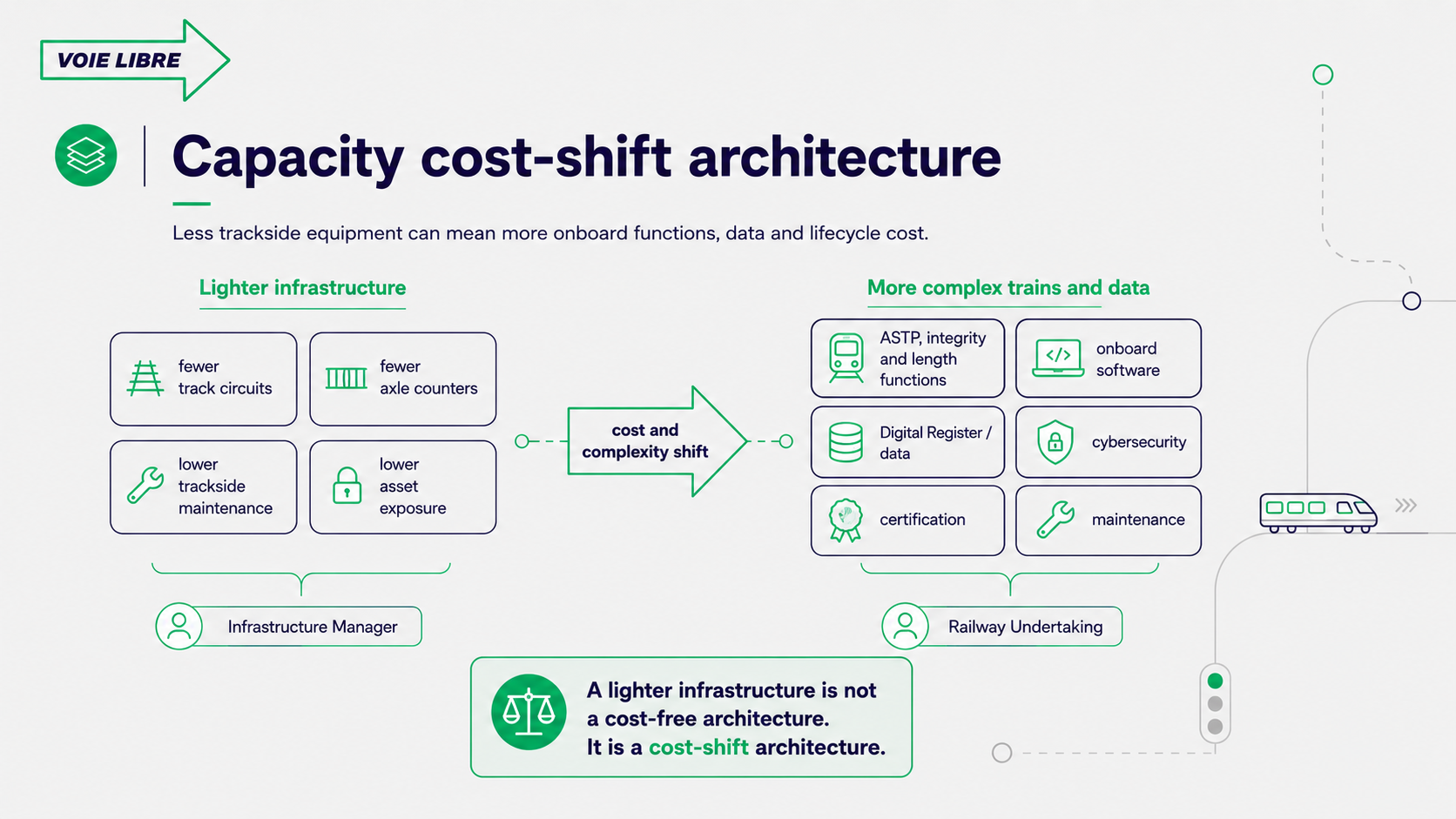
Figure 5 — Capacity cost-shift architecture: lighter infrastructure can mean more onboard functions, data and lifecycle cost.
11. Architecture perspective
From an architecture perspective, the migration from fixed blocks to Moving Block is a migration from infrastructure-centric detection towards train-centric capacity.
In fixed-block signalling, the infrastructure detects train presence and defines the basic granularity of capacity. The train is supervised, but the trackside detection sections remain central.
In ETCS Level 2, signalling becomes digital and cab-based, but conventional fixed-block logic may remain. The train receives radio-based Movement Authorities, and ETCS supervises movement continuously, but the physical detection sections still strongly shape the capacity envelope.
In Hybrid Train Detection, the train starts contributing more actively. If it can provide safe position, integrity and length, the system can create virtual sub-sections and release infrastructure more finely. The capacity logic begins to use train information.
In Moving Block, the train becomes the central moving object around which separation is calculated. The system uses train position, safe front end, safe rear end, braking capability, infrastructure states and operational data to manage movement more dynamically.
This is not simply a technical sequence. It is an allocation shift.
Some functions that were historically carried by the infrastructure move towards the train. Some data that were implicit in trackside detection must become explicit and exchanged. Some static infrastructure knowledge must be maintained digitally. Some operational decisions must become more precise and better connected to train behaviour.
The architecture must therefore manage five dependencies.
First, train information must be safe and reliable. Position, length and integrity cannot be approximate comfort data; they become safety and capacity inputs.
Second, infrastructure data must be correct and consistently used. A dynamic railway depends on high-quality static data.
Third, traffic management must be integrated. More capacity is only useful if it can be planned, regulated and recovered operationally.
Fourth, rolling stock migration must be credible. A capacity architecture that works only for modern multiple units and excludes freight is not a European solution.
Fifth, the business case must be systemic. Reducing trackside equipment while increasing onboard complexity may make sense, but only if cost, benefit and responsibility are managed across the whole railway system.
This is the architecture lesson of ETCS capacity.
Moving Block is not an isolated signalling upgrade. It is a change in the way the railway system knows where trains are, what track is clear, which movement can be authorised and how capacity is used.
12. Conclusion
ETCS Level 2 is a major step in railway signalling digitalisation. It brings cab signalling, radio communication, Movement Authorities and continuous supervision. But it should not be confused with Moving Block.
Conventional ETCS Level 2 can still rely on fixed physical train detection sections. In that case, the railway is digital from the driver’s perspective, but the capacity granularity remains strongly shaped by physical blocks.
Hybrid Train Detection is the first step towards virtualisation. It keeps physical detection, but adds virtual sub-sections that can be released using train position, confirmed length and train integrity. It is both a capacity improvement and a migration architecture.
Moving Block goes further. It moves towards dynamic, train-centric separation. The system manages train objects, safe rear ends, movement permissions, infrastructure states and operational data rather than relying mainly on fixed block boundaries.
But these technologies do not create capacity alone.
They depend on onboard capabilities, especially safe positioning, train integrity and confirmed train length. They depend on reliable static infrastructure data. They depend on freight migration. They depend on TMS, Plan Execution and operational rules. They depend on ERTMS/ATO to make train behaviour more predictable. They depend on business models that distribute costs and benefits fairly between infrastructure and rolling stock.
This is why capacity must be understood as a system property.
The railway can increase its capacity envelope through Hybrid Train Detection and Moving Block. But usable capacity will depend on whether the rest of the railway architecture can operate inside that envelope.
The future capacity architecture is therefore not only about reducing blocks. It is about making trains, infrastructure, data, traffic management and operations work together with enough precision, safety and predictability to run the railway closer to its real potential.
That is the journey from fixed blocks to Moving Block.
Documentation
Voie Libre articles
- ERTMS: The European Rail Traffic Management System
- ERTMS/ETCS: The European Train Control System
- ERTMS/ATO: Europe’s Interoperable Train Autopilot
- Migration to ERTMS/ATO: Lineside Signalling Interpretation
- Railway Automation: From Automatic Driving to Autonomous Operation
- Traffic Management System: From Traffic Supervision to Automated Railway Operations
- Remote Driving: From Technical Train Movements to GoA4 Degraded Operation
European and R&D documentation
- ERA / UNISIG / EEIG ERTMS Users Group — SUBSET-026-2, System Requirements Specification, Chapter 2, Basic System Description, Issue 4.0.0
- ERA / UNISIG / EEIG ERTMS Users Group — SUBSET-026-3, System Requirements Specification, Chapter 3, Principles, Issue 4.0.0
- FP2-R2DATO — D15.1, HL3 System Specification with identification of use cases and related engineering rules
- FP2-R2DATO — D13.1, Moving Block Specifications applying a train-centric approach, Introduction
- FP2-R2DATO — D13.1, Part 1, System Definition
- FP2-R2DATO — D13.1, Part 2, System Specification
- FP2-R2DATO — D13.1, Part 3, Safety Analysis
- FP2-R2DATO — D19.1, Train Integrity and Train Length Architecture & Functional Requirements
- FP2-R2DATO — D21.1, Operational requirements and system capabilities of an ASTP system
- FP2-R2DATO — D21.2, System requirements of ASTP system
- FP2-R2DATO — D27.2, Specification of Digital Register Implementation(s) required in R2DATO
- FP1-MOTIONAL — D8.3, Developed Simulation Methods and Models for Capacity Evaluation of ETCS and C-DAS/ATO