
There are 4 levels of railway automation: from manual driving supervised by an automatic train protection system, to fully automated and unattended operation. To distinguish the levels of automation, one possible definition is the Grade of Automation (GoA) from 1 to 4. GoA0 corresponds to the total absence of automation.
Latest update: 2026-01
Reading time : 4 min
Railway grades of automation by Bastian Simoni is licensed under CC BY-NC-SA 4.0


Railway automation levels
Railway signalling and automation technologies offer different levels of automation for train operation. One definition proposed by the UITP (International Association of Public Transport) is the Grade of Automation (GoA), from 0 to 4.
- GoA0: driving on sight,
- In driving on-sight, the driver controls the train according to what he sees in the environment (signals, obstacles, hazards). There is no device to supervise his driving. Driving on-sight is commonly used on trams, where speeds remain low.
- GoA1: manual driving supervised by a protection system,
- The GoA1 provides a first level of automation, because driving is supervised by a protection system: an ATP (Automatic Train Protection).
An ATP can protect the train against passing closed signals and exceeding a speed limit, by automatically braking the train.
- The GoA1 provides a first level of automation, because driving is supervised by a protection system: an ATP (Automatic Train Protection).
- GoA2: automatic driving with automated traction and braking, supervised by a protection system,
- In this level, an autopilot generates the traction and braking instructions and sends them to the train: this is the ATO (Automatic Train Operation).
- The ATO generates these instructions within the limits of the signalling, supplied by the ATP, and the timetable for the mission to be carried out, supplied by the traffic management system.
- The ATP continues its supervision, and automatically applies the emergency braking if the ATO does not comply with the signalling.
- The driver remains in the cabin and continues to observe the environment, so as to regain control if the situation deteriorates.
- GoA3: automatic driving with automated traction and braking, without personnel in the cabin but with personnel on board,
- In GoA3, there is no longer a driver in the cab. Environmental hazards (obstacles, dangers) must be supervised by other means.
Staff remain on board to advise passengers and intervene in degraded situations.
- In GoA3, there is no longer a driver in the cab. Environmental hazards (obstacles, dangers) must be supervised by other means.
- GoA4: automatic and unattended driving without any staff on-board,
- This is the most advanced level of automation.
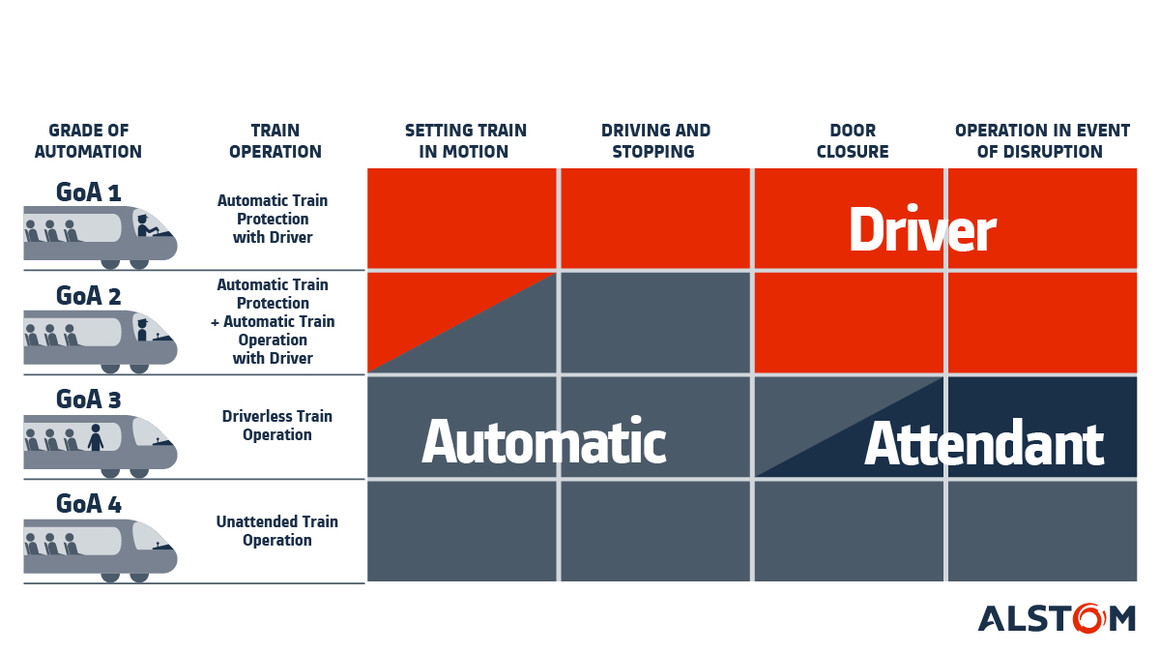
Railway automation levels (ALSTOM).
Cover picture : Bastian Simoni.