
Written by Bastian Simoni
Bastian Simoni is a railway system architect working at the intersection of signalling, automation and digital railway operations. Voie Libre is his personal blog on the system architecture behind the future European railway: ERTMS, DATO, automation, migration and interoperability.
This article by Bastian Simoni is licensed under CC BY-NC-SA 4.0


Introduction
The European railway sector faces growing pressure to improve transport capacity, operational efficiency and economic competitiveness. At the same time, demographic change, energy constraints and decarbonisation policies could significantly reshape European mobility over the coming decades.
These pressures are compounded by structural challenges within the railway sector itself. Workforce ageing and recruitment difficulties constrain the availability of operational resources, while fragmented national practices and technical systems continue to increase costs and complicate cross-border operations.
The implications can be examined through an Enterprise Architecture perspective, considering the European railway sector as an interconnected enterprise comprising railway undertakings, infrastructure managers, suppliers and public authorities. This interpretation is consistent with the multi-organisational approach described in the NATO Architecture Framework v4.1.
Two concepts structure the analysis: Socio-economic Demands, arising from the wider economic and societal environment, and Enterprise Needs, expressing the capabilities and performance expected from the railway sector.
DATO is considered in this context as one possible contributor to meeting those needs.
1. A Railway System Under Multiple Pressures
Energy constraints and the transformation of mobility
European mobility remains heavily dependent on fossil fuels. Decarbonisation policies aim to reduce this dependency, but the future availability of oil introduces an additional constraint.
In its 2021 study on the European Union’s future oil supply, The Shift Project examined the production prospects of 16 countries accounting for approximately 95% of EU crude oil imports in 2018. The study projected a risk of combined production declining by 10–20% during the 2030s compared with 2019 levels.
These projections concern the production of historical suppliers, not future EU imports. The availability of alternative suppliers, changes in global demand and the pace of energy substitution will influence the actual consequences for Europe. Nevertheless, the study identifies a potential physical constraint that could reinforce the need to reduce the dependence of mobility on oil.
The transformation of mobility extends beyond vehicle electrification.
According to The Shift Project’s 2022 Voyager bas carbone report, a substantial reduction in the energy and carbon intensity of long-distance travel in France could be achieved through changes in transport modes and travel practices.
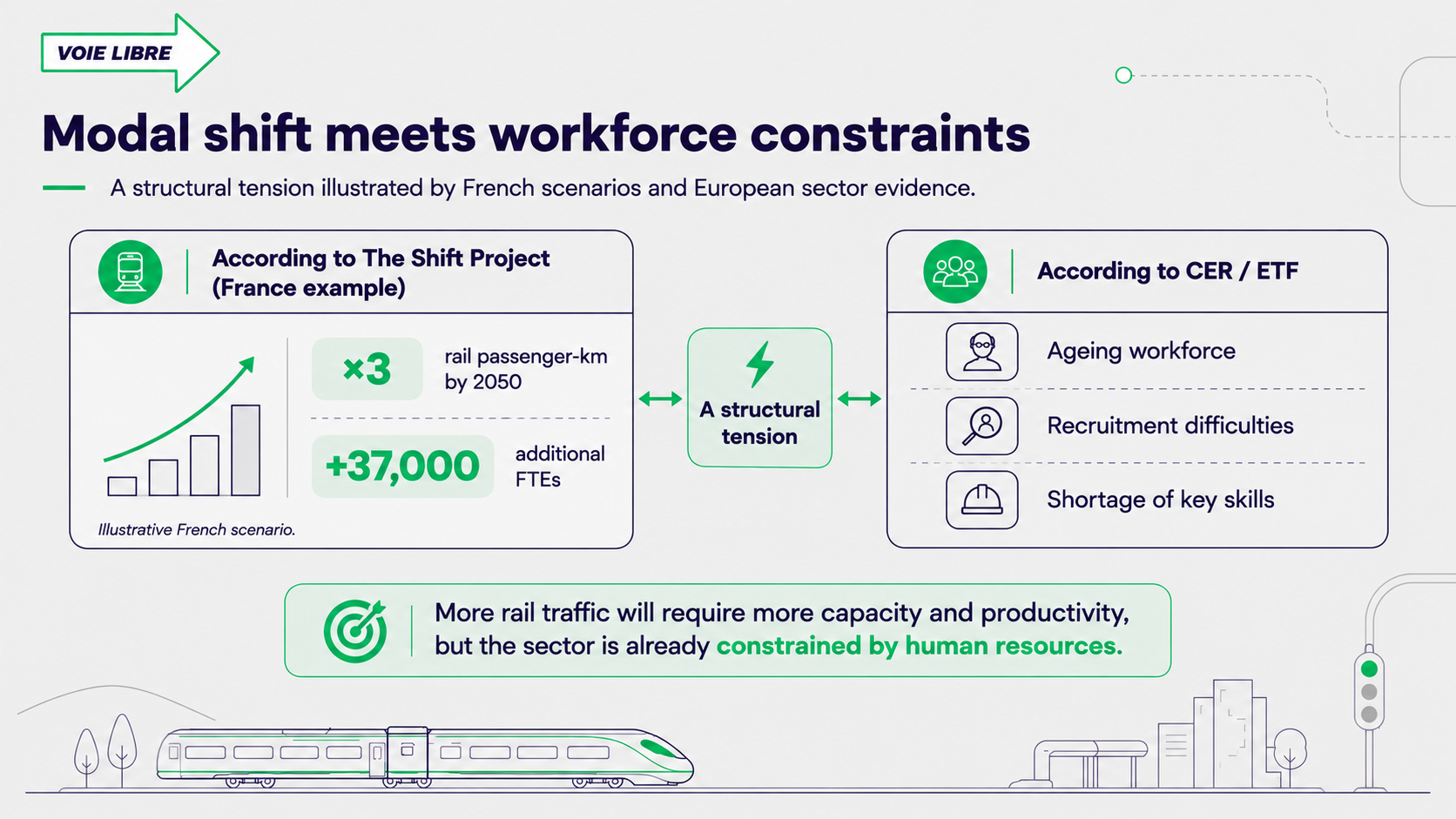
Its proposed scenario for 2050 combines broadly stable overall long-distance mobility with a threefold increase in railway passenger-kilometres, alongside reduced car and air travel.
This French scenario illustrates an important possibility for European railways: rail transport demand could increase substantially through modal shift, even without an overall increase in mobility.
The Shift Project’s 2021 guide to low-carbon daily mobility further demonstrates that modal shift depends on the wider mobility system. Public transport services must be accessible, reliable and connected to other modes. Changes in urban planning, pricing and travel behaviour are equally important.
Railway transport is therefore one component of a broader transformation. Its ability to accommodate changing mobility needs depends on the attractiveness and performance of the services it provides.
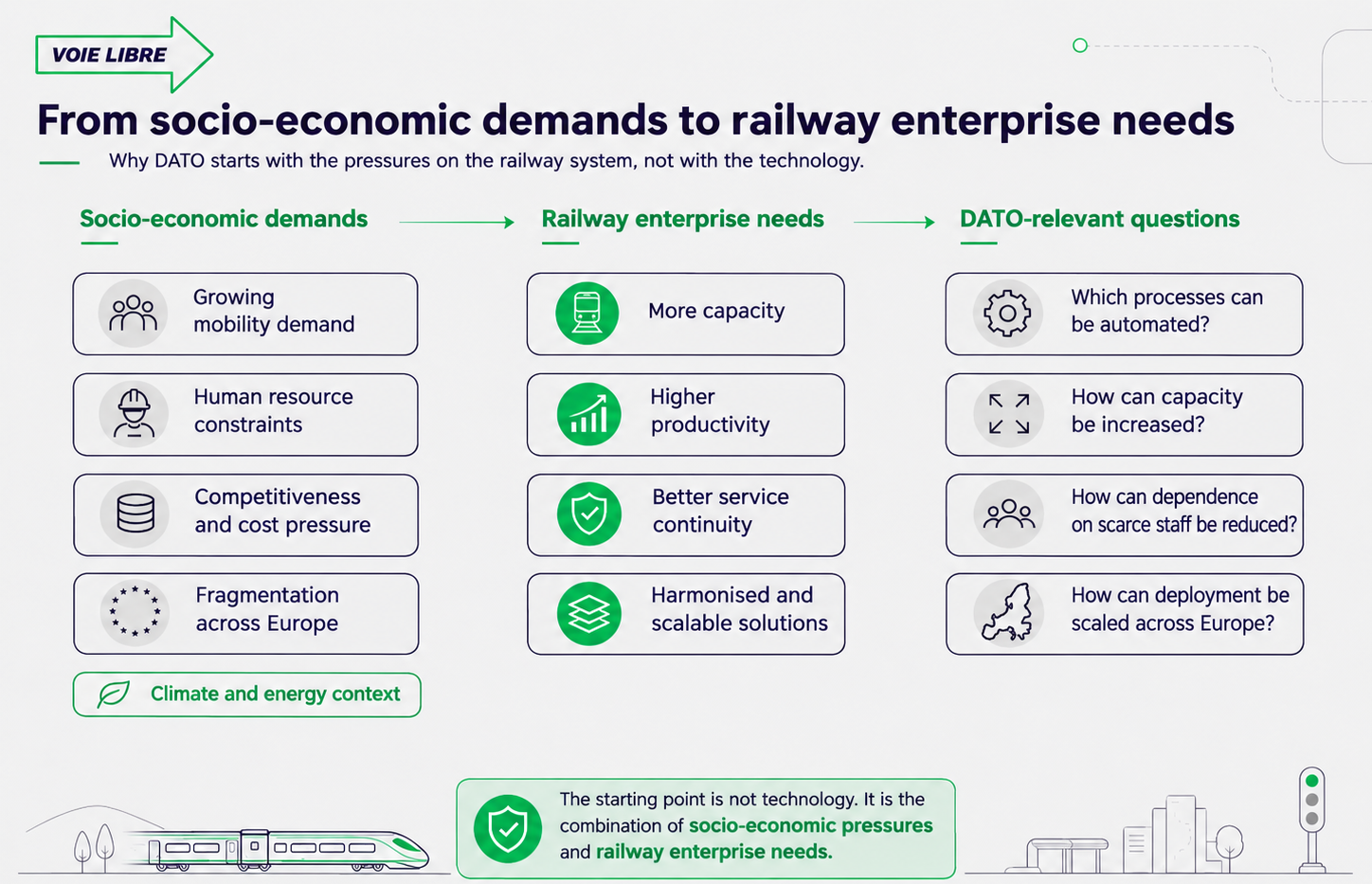
2. From Socio-economic Demands to Railway Enterprise Needs
Socio-economic pressures translate into concrete expectations for the European railway system.
The Europe’s Rail System Pillar Common Business Objectives identify improved transport capacity, service quality, cost efficiency, sustainability, resilience and interoperability among the principal objectives of the sector.
Capacity is a central concern. According to the System Pillar, accommodating increased demand will require additional infrastructure in some areas, but much of the capacity improvement must come from making better use of existing railway assets.
This places operational performance alongside infrastructure investment.
The sector must increase the effective utilisation of its infrastructure, improve service reliability and adapt transport capacity to changing demand. The System Pillar also identifies reduced travelling and transit times, better anticipation of capacity requirements and more efficient use of lightly utilised lines as business objectives.
Economic competitiveness is equally important.
Rail must provide an attractive alternative to other transport modes while controlling operating and lifecycle costs. According to the System Pillar, the cost of railway services remains a barrier to competitiveness in several market segments.
The Shift Project’s studies reinforce the relationship between attractiveness and modal shift. Travellers will not necessarily choose rail because it offers lower emissions. The overall journey must also meet their expectations in terms of accessibility, convenience, journey time and reliability.
Taken together, these demands define a substantial transformation challenge: the railway sector must improve its capacity and service offering while maintaining economic competitiveness and adapting to evolving mobility needs.
3. The Structural Challenges Facing European Railways
Workforce availability and operational productivity
The railway sector relies heavily on human resources across operations, maintenance, infrastructure management and supporting activities.
In their 2022 study on employability, digitalisation and automation, the European social partners CER and ETF identify workforce ageing, recruitment difficulties and changing skill requirements among the challenges facing European railways.
These constraints become particularly significant when considered alongside scenarios for expanded railway activity.
The Shift Project’s Voyager bas carbone scenario estimates that transforming French long-distance mobility along its proposed pathway would require approximately 37,000 additional full-time-equivalent jobs in the railway sector.
This is an estimate associated with a French transformation scenario, not a forecast of European employment. It nevertheless illustrates the potential scale of the resources needed to accommodate a substantial modal shift towards rail.
The combination of increasing operational requirements and workforce constraints raises a fundamental issue for the sector: improving productivity while sustaining safe, reliable operations and adapting skills and responsibilities.
Automation may contribute to this objective. However, as the CER and ETF study highlights, digitalisation and automation also require changes in competencies, work organisation and social dialogue.
The issue extends beyond workforce numbers to the way railway activities are organised and performed.
Technical and operational fragmentation
Fragmentation constitutes another major barrier to railway competitiveness.
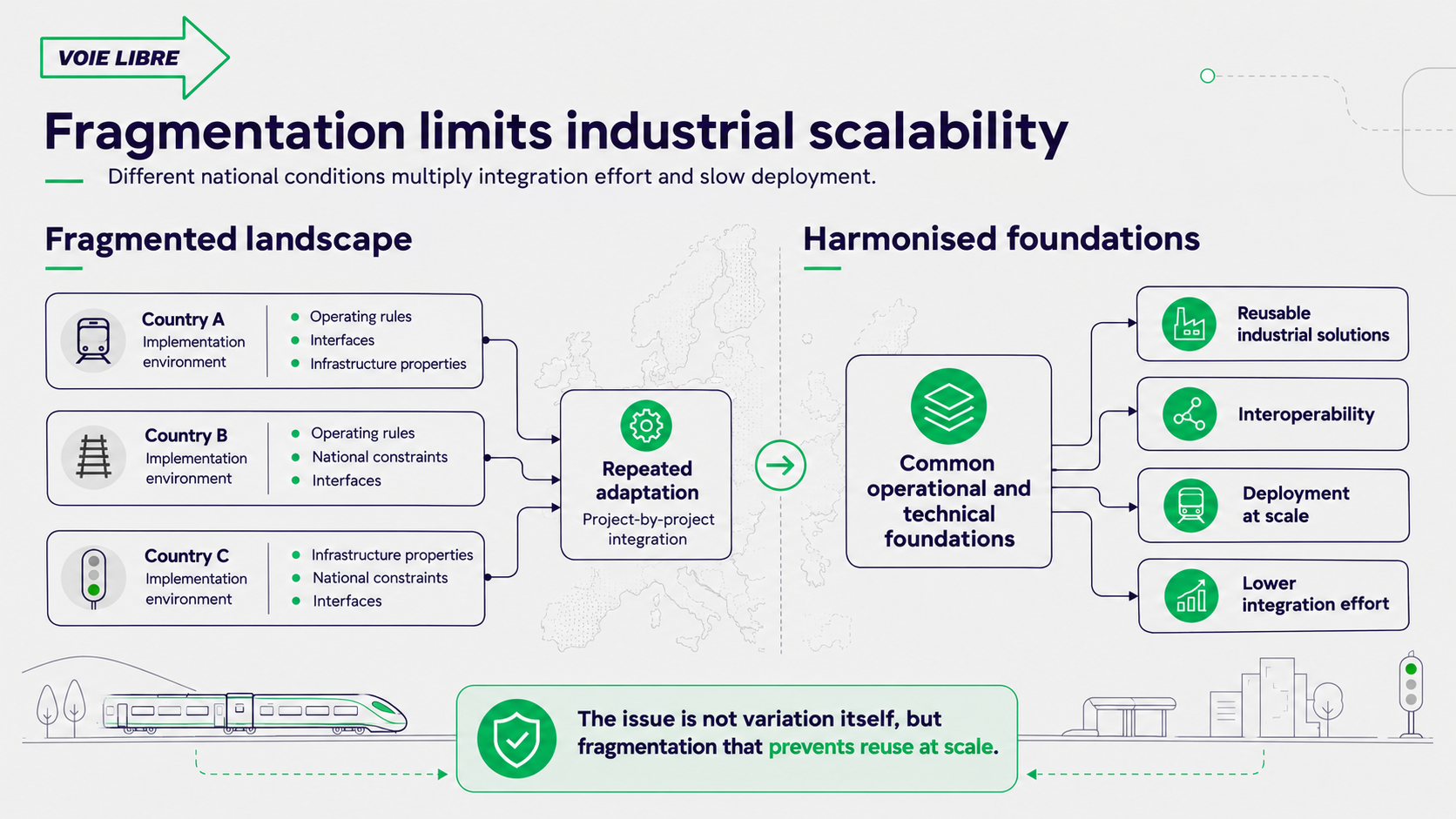
In their 2023 position paper on Railway System Architecture, CER and EIM describe the consequences of national and regional railway system development. The resulting heterogeneity complicates interoperability and makes coordinated system evolution difficult and costly.
According to the EIM’s 2026 white paper on ERTMS non-standardisation, fragmented national specifications, supplier dependency and repeated authorisation processes restrict economies of scale and increase railway modernisation costs.
The EIM identifies multiple contributors to this situation, including national engineering and operational rules, project-specific industrial developments and additional national requirements introduced during authorisation.
These differences affect both economic performance and the ability to develop railway solutions that can be deployed consistently across Europe.
They also create difficulties for international railway operations, where different national rules and technical implementations must be accommodated within the same transport service.
Industrial scalability
The scale of future railway modernisation makes these issues increasingly difficult to ignore.
The European Commission’s Third ERTMS Work Plan, published in 2026, identifies the need to accelerate ERTMS deployment and improve industrial scalability. It also highlights the importance of harmonising operational and engineering rules, system interfaces and authorisation processes.
The underlying economic challenge is to move away from repeated project-specific developments towards solutions that can be manufactured, integrated and deployed on a larger scale.
This is directly relevant to DATO. Greater automation will introduce changes across railway operations, organisations and systems. Without sufficient harmonisation, these changes could reproduce existing fragmentation rather than improve European railway performance.
4. What Could DATO Contribute?
The preceding demands and constraints provide the rationale for examining DATO.
They do not establish that automation can address every railway enterprise need, nor do they determine which degree of automation is appropriate.
Infrastructure development, changes in operational rules, workforce transformation, industrial standardisation and mobility policies remain necessary contributors to railway system performance.
DATO can be examined through the operational outcomes it could support.
| Socio-economic Demand or Sector Constraint | Railway Enterprise Need | DATO-relevant Question |
|---|---|---|
| Energy transition and potential fossil-fuel supply constraints | Provide efficient and attractive alternatives to fossil-fuel-dependent mobility | How could automation improve railway operational efficiency and attractiveness? |
| Evolving mobility demand and modal shift | Increase capacity, service quality and adaptability | How could automated operations help accommodate a greater share of mobility demand? |
| Economic competitiveness | Improve productivity and reduce operating and lifecycle costs | Which operational activities could benefit from automation? |
| Demographic change and workforce pressures | Sustain operations while adapting workforce needs and competencies | How could automation support the evolution of operational roles and responsibilities? |
| Technical and operational fragmentation | Improve harmonisation, interoperability and industrial scalability | How could common automated operational capabilities reduce fragmentation? |
| Climate change and operational disruptions | Improve robustness and service recovery | How could automation contribute to more resilient railway operations? |
The matrix distinguishes documented enterprise needs from questions concerning DATO’s potential contribution. Technical and operational fragmentation is treated as an internal sector constraint rather than an external socio-economic demand.
Several enterprise needs are influenced by more than one pressure. Increasing railway capacity, for instance, may respond to modal shift, competitiveness requirements and changes in mobility patterns. Improving operational productivity may address both economic costs and human-resource constraints.
Conversely, one enterprise need may require several complementary transformations. Railway capacity cannot always be increased through operational improvements alone. Infrastructure investments may still be necessary.
The contribution of DATO therefore needs to be evaluated against specific enterprise needs and expected operational outcomes.
The same applies to harmonisation. Automated railway operations must be considered at the scale of the European railway system to avoid reinforcing national or project-specific differences.
5. From Enterprise Needs to System Transformation
European railways face a combination of external pressures and internal constraints. Energy transition and changing mobility patterns may increase the role of rail in the transport system, while competitiveness, workforce availability and fragmentation limit the sector’s ability to respond.
The resulting enterprise needs are already reflected in the objectives developed by the Europe’s Rail System Pillar: improved capacity, operational performance, cost efficiency, resilience and harmonisation.
DATO provides one possible means of contributing to these objectives through the transformation of railway operations.
Determining its contribution requires an understanding of the operational capabilities to be developed, the activities involved and the changes required across the railway system.
This establishes the next question for Deploying DATO: how can enterprise needs be translated into a coherent transformation of railway operations, and how can that transformation be progressively deployed?