
European railways have spent almost three decades deploying ERTMS/ETCS. The technology has established a common European framework for train protection, yet deployment remains slow, expensive and fragmented. Much of the difficulty has come not from ETCS alone, but from the railway systems into which it has been introduced.
Digital Automated up to Autonomous Train Operation (DATO) presents a broader challenge. It brings together automation capabilities ranging from GoA2 to GoA4, as well as Remote Driving. Their introduction can change not only the technologies used by railways, but also operational processes, responsibilities and the way railway undertakings and infrastructure managers work together.
The needs driving this transformation were explored in Why DATO? The Structural Challenges Facing European Railways. The next question is how to translate these needs into capabilities that railway organisations can realistically deploy.
The experience of ERTMS/ETCS offers important lessons. DATO should not become another layer of technology added to an already complex railway system. Its deployment should help simplify that system while creating the conditions for progressive, economically viable automation.
Written by Bastian Simoni
Bastian Simoni is a railway system architect working at the intersection of signalling, automation and digital railway operations. Voie Libre is his personal blog on the system architecture behind the future European railway: ERTMS, DATO, automation, migration and interoperability.
This article by Bastian Simoni is licensed under CC BY-NC-SA 4.0


1. Three Decades of ERTMS/ETCS: Lessons from Deployment
ERTMS/ETCS was developed to overcome the fragmentation of national train protection systems and enable interoperable railway operations across Europe. Almost thirty years later, its deployment is still far from complete. According to the European Coordinator’s Third ERTMS Work Plan, published in February 2026, ETCS was operational on approximately 10% of the trans-European transport network at the end of 2024, while around 19% of the EU railway fleet was equipped.
One explanation lies in the way signalling systems have traditionally evolved. National interlocking systems and signalling principles were progressively complemented by automatic train protection systems. ERTMS/ETCS was then introduced into environments that already contained several generations of technology.
ETCS Level 1 illustrates this approach. It can be implemented while retaining existing interlockings and lineside signalling, allowing railways to introduce interoperable train protection without fundamentally changing their signalling architecture. This can be a useful migration strategy, particularly where the existing infrastructure still has a long remaining service life. However, the resulting system may retain much of its previous complexity.
ETCS Level 2 offers greater opportunities for modernisation, but installing a Radio Block Centre (RBC) does not automatically simplify the surrounding signalling system. When existing interlockings and national signalling rules are retained, the ETCS implementation must accommodate their characteristics.
The 2026 ERTMS Work Plan identifies this problem explicitly. Infrastructure managers frequently require ETCS implementations to reproduce existing national signalling rules. Interfaces with interlockings become particularly complex, while suppliers must develop and maintain solutions adapted to individual infrastructure managers. This increases engineering effort and limits opportunities for industrial standardisation.
The sector is increasingly addressing these difficulties through more integrated modernisation strategies. In France, SNCF Réseau’s ARGOS programme introduces a new generation of digital interlockings and prepares the network for ERTMS. In Germany, the Digital Stellwerke (DSTW) programme forms part of a broader strategy combining digital signalling and ETCS.
These approaches create opportunities to reconsider engineering rules, reduce equipment diversity and simplify interfaces instead of reproducing historical arrangements. They do not imply that every ETCS Level 2 deployment must replace all existing interlockings. They demonstrate, however, that ETCS deployment can be part of a wider system modernisation.
This also changes the economic perspective. Replacing additional assets may increase the initial investment, but could reduce integration, engineering and maintenance costs over the system lifecycle. The relevant comparison is therefore not limited to installation costs. It must consider the Total Cost of Ownership (TCO) of the resulting railway system.
2. DATO Multiplies the Deployment Challenge
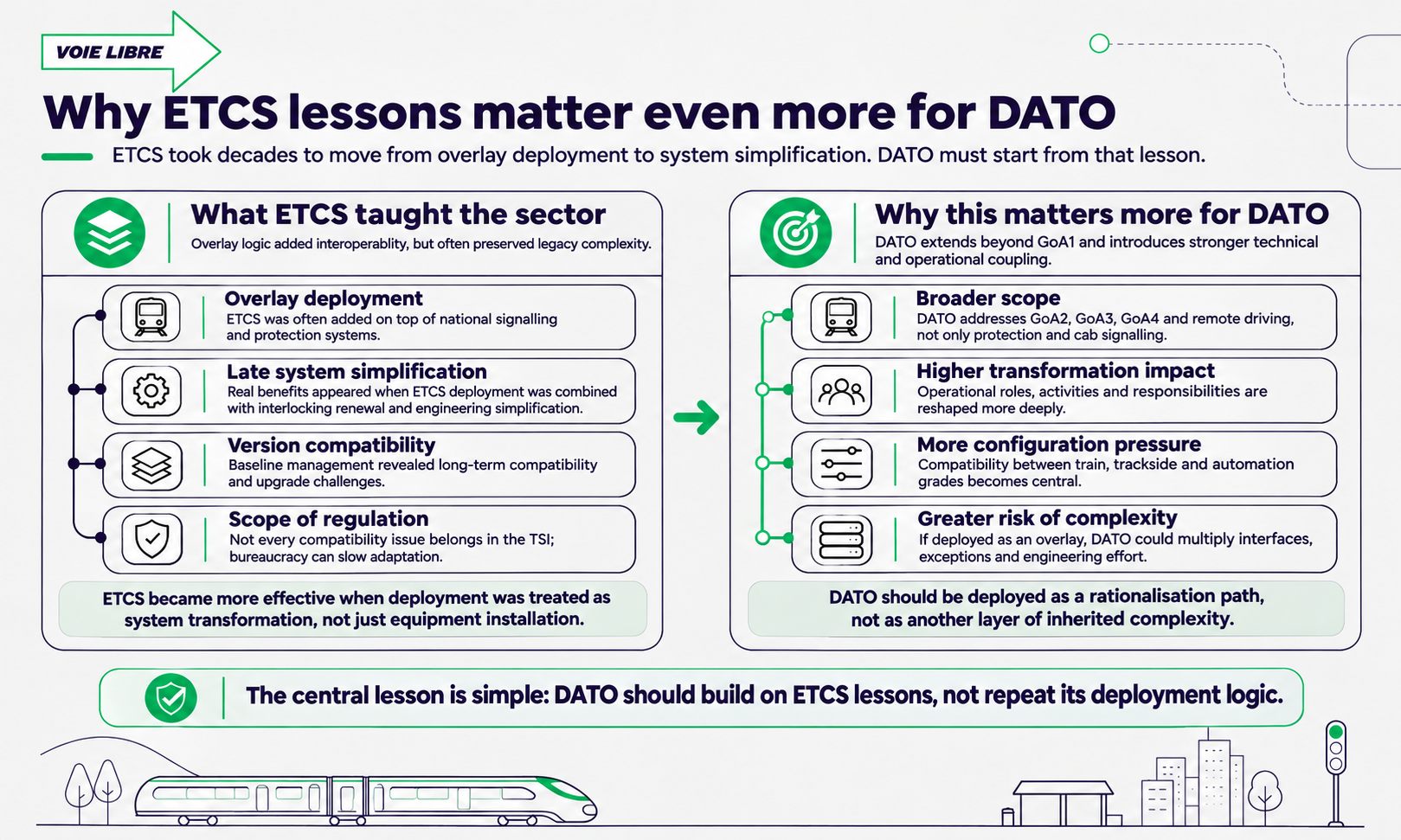
ETCS primarily provides train protection and cab signalling. It enables GoA1 operation and remains an essential safety foundation for higher grades of automation.
DATO extends the scope considerably. Automatic Train Operation, unattended train operation and Remote Driving introduce capabilities that depend on several technical and operational domains working together.
Deploying such a capability involves more than installing its supporting equipment. It may require changes to operational activities, the people or systems performing them, the allocation of responsibilities and the conditions under which operations are executed.
Remote Driving provides a useful example. Its technical implementation may involve communication systems, onboard control interfaces, video, cybersecurity and train supervision. Its operational introduction also requires decisions about when remote operation is permitted, who assumes control, how responsibility is transferred and what happens if communication is lost.
The distinction between an automation capability and the technologies supporting it is important. A solution may be technically available while the railway organisation is not yet prepared to introduce the corresponding operational changes.
DATO therefore increases the number of dependencies that deployment strategies must address. If every capability is integrated independently into existing national environments, the sector risks repeating the difficulties experienced with ETCS, but across a much larger part of the railway system.
3. Technology Overlay or System Transformation?
Most DATO deployments will take place on existing railways, with infrastructure, rolling stock, operational rules and technical systems that cannot simply be replaced overnight.
Consider the introduction of Remote Driving on a network still using national train protection systems. Depending on its intended application and operating conditions, such a capability may be technically feasible without first replacing the entire signalling system with ERTMS/ETCS.
The immediate project could therefore concentrate on integrating the new function into the existing environment. This may involve adapters, additional interfaces and specific engineering solutions.
Such an approach can be justified. It limits the initial scope of change and may allow operational benefits to be realised earlier.
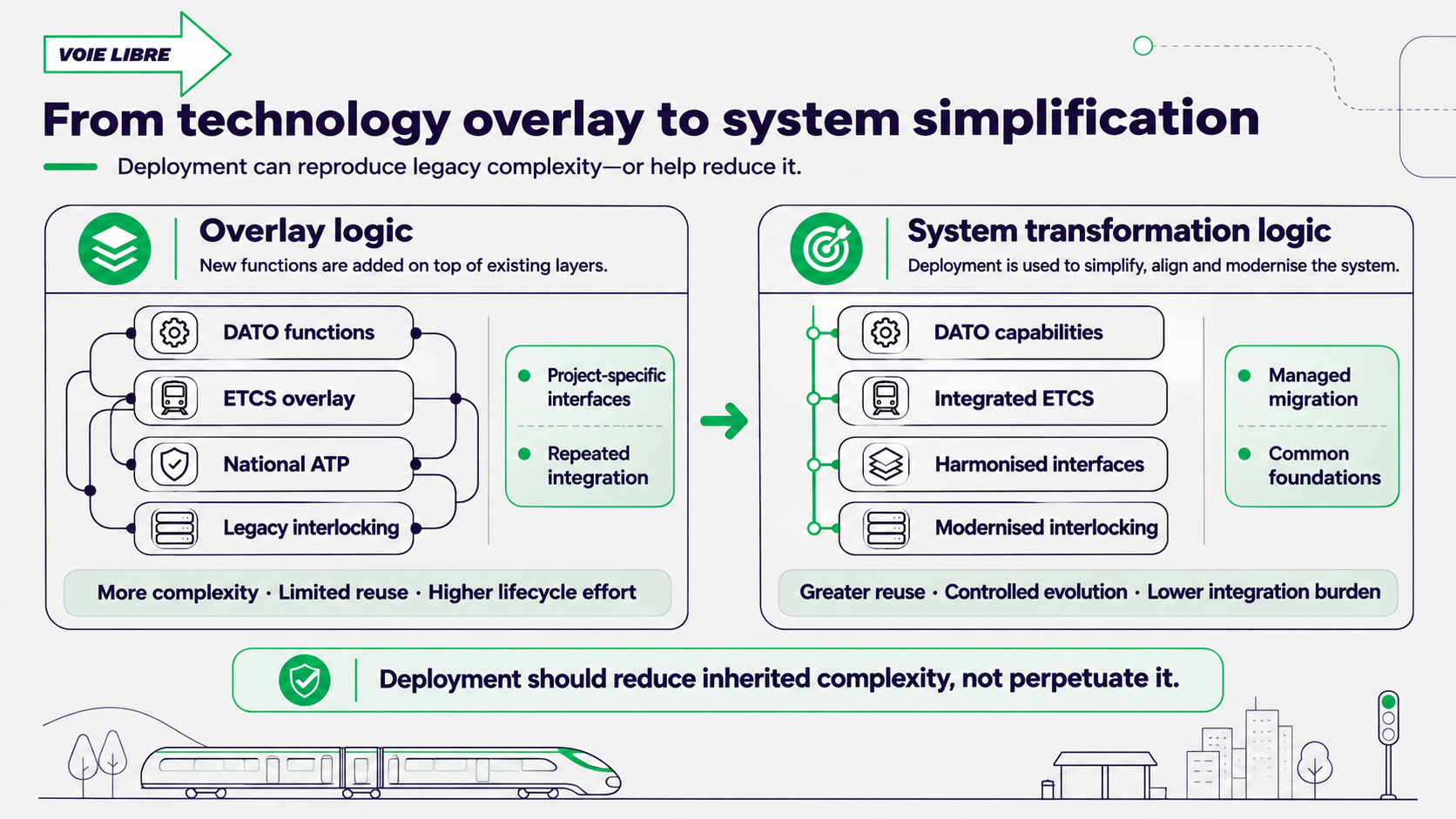
The difficulty arises when this becomes the permanent deployment model. If every railway undertaking or infrastructure manager requires different adaptations, DATO products may progressively inherit the diversity of the systems surrounding them. Engineering work must then be repeated across projects, limiting reuse, increasing costs and reducing industrial scalability.
The 2026 EIM White Paper on the economic burden of non-standardisation documents how national variants, project-specific requirements and proprietary dependencies have contributed to precisely these problems in ERTMS deployment.
DATO therefore raises an important choice: should new automation capabilities primarily adapt to the existing railway, or should their introduction also contribute to replacing and rationalising the systems around them?
These strategies are not mutually exclusive.
As discussed in DATO as a System-of-Systems, technology infusion allows new capabilities to be introduced progressively, using adapters where necessary to connect them to existing systems.
The key distinction is whether these adaptations constitute a managed transition towards a harmonised architecture or become permanent additions to the system.
A DATO project could, for example, be an opportunity to accelerate migration towards ERTMS/ETCS, replace obsolete interfaces or simplify existing operational arrangements. In other circumstances, retaining existing assets may remain the economically appropriate solution.
The decision must account for the current environment, the remaining life of existing equipment, the operational changes required and the longer-term migration trajectory.
Technical modernisation and operational transformation must also be considered together. Replacing equipment does not necessarily simplify operations if the underlying processes and responsibilities remain unchanged. Conversely, a change in operational processes may require new technical capabilities without requiring a complete infrastructure renewal.
The objective is not to maximise the scope of every project. It is to ensure that each deployment contributes to a coherent evolution of the railway system rather than creating additional long-term dependencies.
4. Aligning Investments, Deployment and Benefits
ERTMS/ETCS was introduced primarily to establish an interoperable European train control system. Its benefits extend beyond interoperability, including opportunities to improve safety, capacity and operational performance.
However, those benefits depend heavily on how ETCS is implemented. When the system is added to national train protection systems that already meet operational requirements, the additional benefits for individual railway organisations may be limited compared with the investments required.
This creates a business case problem. A deployment may support an important European objective without producing equivalent economic benefits for every organisation contributing to it.
DATO introduces new opportunities for operational value. Automated driving, unattended operation and Remote Driving may support productivity, capacity, cost reduction or service continuity, depending on the operating context.
Yet the investments needed to realise these benefits may be distributed across several organisations.
A railway undertaking may need to equip its rolling stock while the infrastructure manager must upgrade its signalling, communications or operational systems. The benefits may materialise primarily for one party, even when the other carries a significant share of the costs.
This difficulty is explicitly recognised by the OCORA initiative, which notes that costs and benefits are not necessarily distributed evenly between railway undertakings and infrastructure managers and that financial arrangements may be needed to support cooperation.
The timing of investments adds another dimension.
For capabilities requiring complementary onboard and trackside equipment, benefits can only be realised when the necessary configurations are operationally available together. Equipping a train may create little immediate value if the infrastructure is not ready. The reverse can also be true.
ERTMS deployment has already demonstrated the importance of coordinating these investment cycles. With DATO, the dependencies may extend further, involving operational processes, staff competencies, maintenance arrangements and supervision systems.
Deployment strategies must therefore consider not only which capabilities are technically ready, but also who must invest, when complementary transformations can be completed and under which conditions the expected benefits become accessible.
Without this coordination, technologically successful projects can leave railway organisations carrying costs long before they can realise the corresponding value.
5. Protecting Investments Through Evolvability
The long-term management of ETCS versions provides another important lesson.
ETCS baselines and system versions have evolved to introduce new functions, correct specifications and address operational needs. However, compatibility between generations of onboard and trackside systems has not always been symmetrical.
Historically, the compatibility strategy has placed significant emphasis on newer onboard equipment remaining compatible with earlier trackside configurations. The reverse is not necessarily guaranteed when new trackside functions require more recent onboard capabilities.
These are architectural choices with important consequences for migration.
For railway undertakings, upgrading an ETCS version can require substantial engineering, testing and authorisation effort. Where software and hardware remain closely coupled, even a functional upgrade may involve replacing equipment that would otherwise remain serviceable.
DATO increases the significance of this problem. Multiple applications and constituents may evolve at different rates, while trains and infrastructure remain in service for decades. A change affecting one application should not systematically require extensive modifications to unrelated parts of the system.
This brings us to the debate about specification stability.
In its September 2026 ERTMS Vision Paper, UNIFE advocates slowing unnecessary technical and regulatory changes, improving requirement maturity and reducing the burden of continuously evolving specifications.
This concern is legitimate. Railway undertakings, infrastructure managers and suppliers need predictable requirements to develop products, authorise them and recover their investments.
But software-based systems cannot remain unchanged indefinitely. Defects must be corrected, cybersecurity vulnerabilities addressed and new operational requirements accommodated. Communication technologies and computing platforms also have different lifecycles from rolling stock and infrastructure.
A useful distinction is therefore needed between stability of specifications and the ability of the system to evolve.
Specifications should be mature, consistent and sufficiently stable to support industrial investment. At the same time, the architecture must allow necessary changes without repeatedly invalidating previous investments.
OCORA addresses this challenge directly. Its Guiding Principles propose modular onboard CCS architectures, standardised interfaces, portable software and greater independence between hardware and software lifecycles.
The objective is to enable selected components to be upgraded or replaced without affecting the entire onboard system.
OCORA also recognises that modularity has a cost. More interfaces require additional specification, integration and testing effort. The appropriate level of modularity must therefore be determined by the expected benefits, not by an ambition to make every component independently replaceable.
A similar discipline is needed in standardisation and regulation. Requirements essential to interoperability, safety and technical compatibility must be addressed through the appropriate European framework. Other industrial design choices need not automatically become legally prescribed requirements when they can be managed through suitable standards and specifications.
The objective is to protect investment confidence without preventing the system from adapting to changing needs.
For DATO, evolvability is therefore part of the deployment problem itself. A capability that is affordable to introduce but prohibitively expensive to update may not offer a sustainable migration path.
6. From Technological Maturity to Deployability
Research and innovation programmes are progressively increasing the maturity of DATO technologies. Yet technological maturity alone does not establish the conditions for deployment.
A technically mature solution may still require substantial transformation before a railway undertaking or infrastructure manager can use it in regular operations.
The required changes may affect operational processes, staff roles, training, safety responsibilities, technical interfaces, maintenance arrangements, investment planning or authorisation.
The scale of this effort depends on the railway context. Introducing the same automation capability on two networks may require very different transformations because their existing systems, operational practices and economic constraints differ.
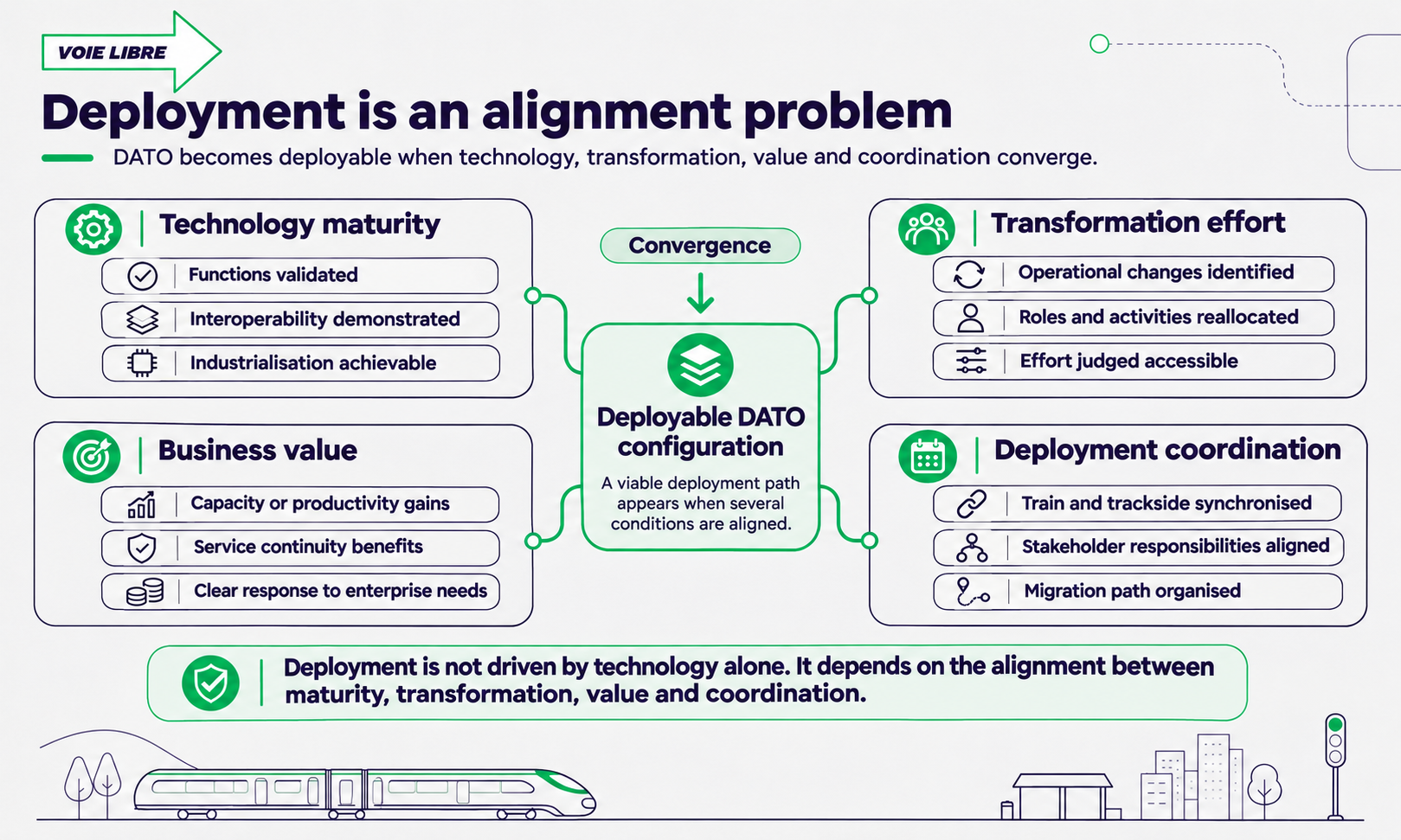
DATO deployment therefore depends on an alignment between the maturity of the technical solutions and the transformation effort considered accessible by the stakeholders concerned.
This does not mean that every organisation must be ready to adopt every automation capability at the same time.
It means identifying deployment opportunities where a sufficiently mature technical solution can support a meaningful railway capability, where the necessary operational changes are achievable and where the expected benefits justify the investment.
The concept of Migration Plateaus, developed in the 2023 CER/EIM position paper on Railway System Architecture, provides a useful foundation. It proposes intermediate stages that protect investments, preserve business continuity and enable access to new functionalities while progressing towards a harmonised target architecture.
Applied to DATO, this principle suggests coordinating two forms of progression.
On the industrial side, technologies move through development, integration, validation and industrialisation. On the railway side, organisations progressively develop the ability to introduce new capabilities into their operations.
These two trajectories must inform each other.
An initial deployment may be limited in scope but sufficiently mature and operationally useful to establish a credible market opportunity. Further increments can expand the supported capabilities, operational contexts and technical configurations as both solutions and organisations evolve.
Such increments should remain consistent with the wider migration trajectory. Otherwise, short-term deployment opportunities may reproduce the fragmentation they were intended to overcome.
This approach does not require waiting until the complete DATO target system is available. Nor does it justify deploying every technology as soon as it becomes technically feasible.
It requires identifying combinations of technical maturity, operational transformation and economic value that make progressive deployment achievable.
Conclusion — Making DATO Deployable
The experience of ERTMS/ETCS shows that a common European technology can be difficult and costly to deploy when it must accommodate fragmented systems, national engineering practices and poorly coordinated investment cycles.
DATO extends these challenges to a much broader transformation of railway operations.
Its deployment should therefore contribute to simplifying existing systems, protecting investments and creating progressively accessible automation capabilities. This requires coordinating technological maturity with the operational changes that railway undertakings and infrastructure managers can realistically undertake, while ensuring that investments lead to identifiable benefits.
To make these decisions consistently, the sector needs to connect railway enterprise needs with the capabilities being sought, the operational transformations required and the technical solutions available.
Documentation and Further Reading
-
European Commission — Third ERTMS Work Plan of the European Coordinator, 2026.
-
European Rail Infrastructure Managers (EIM) — The Economic Burden of Non-Standardisation of ERTMS in European Railways, 2026.
-
CER & EIM — Position Paper on Railway System Architecture, 2023.
-
UNIFE — Leveraging Stability to Streamline Requirements and Reduce Costs: ERTMS Vision Paper, September 2026.
-
OCORA — Open CCS On-board Reference Architecture: Public Documents, particularly Introduction to OCORA, Guiding Principles, Problem Statements and Economic Model (2025 releases).
-
SNCF Réseau — ARGOS: Next-Generation Signalling.
-
German Federal Ministry of Transport — Digitalisation of Rail: ETCS and Digital Interlockings.